

Product Information
Management and Domain Orchestration
RADview
Radview is a modular network management and edge domain orchestration suite for RAD’s Service Assured Access and Service Assured Networking solutions.
It enables configuration, provisioning, monitoring, and management of networks and services, and includes the following management tools:
• Network element manager
• Performance monitoring portal for ongoing monitoring of Ethernet and IP services
• D-NFV orchestrator for virtual machines and application services at the customer edge
• End-to-end service manager for planning and activation of Carrier Ethernet services
• Service center for managing TDM services
Comprehensive management suite, intuitive UX/UI and open architecture
The RADview features a network element manager, end-to-end service manager for Carrier Ethernet services, performance monitoring portal for ongoing monitoring of Ethernet and IP services, D-NFV orchestrator for virtual machines and application services at the customer edge, and a network planner for resource optimization and capacity planning.
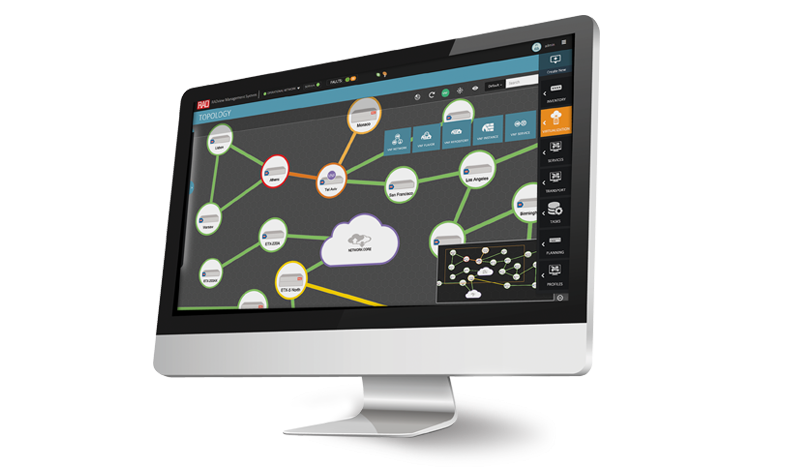
Featuring client/server architecture with multi-user support, RADview provides an intuitive graphic representation of network clouds, links, nodes, end-to-end services, and network status indication. Fully ITU-T FCAPS compliant, it offers security management supporting user access profiles and allowing network partitioning.


Quick Specs
- Monitor device health, optimize network operations and minimize mean time to repair (MTTR)
- Client/server architecture with multi-user support and seamless handover of user privileges
- Zero-touch and auto-discovery capabilities
- Wide range of northbound application programming interfaces (APIs)
- Interoperable with third-party NMS and leading OSS/umbrella systems
- Multi-platform Java-based solution supporting Windows and Linux
- IBM Tivoli’s Netcool®/OMNIbus™ plug-in
- High availability and disaster recovery solutions
Ordering Options
RADview Performance Monitoring
The RADview Performance Monitoring module enables ongoing monitoring of Ethernet and IP service performance by collecting KPI (key performance indicator) data from RAD devices.
Part of RAD’s Service Assured solutions, it allows service providers and network operators to easily monitor and manage the actual network and service performance over time and compare it to service requirements and SLA (service level agreement) guarantees.
The RADview Performance Monitoring module enables immediate detection of service degradation so that remedial actions are taken to quickly restore guaranteed performance levels.
The system retrieves data lost due to connection failures and exports standard CSV ASCII files to OSS or third-party management systems.
- Collect, store analyze and present KPIs from RAD devices
- In-service bandwidth utilization measurements
- Actual performance metrics based on ITU-T Y.1731:
- Frame delay (latency)
- Frame delay variation (jitter)
- Packet delivery ratio
- Availability
- TWAMP-based L3 performance monitoring for IP services
- SLA threshold policy management
- Performance dashboard with aggregated and drill-down views
- Monthly and real-time SLA statistics reporting
RADview D-NFV Orchestrator
The RADview D-NFV Orchestrator uses the OpenStack framework to manage the physical and virtual resources required for effectively running vCPE services and for delivering service agility at the customer edge.
It installs, configures and manages virtual machines on the x86 D-NFV module residing within RAD’s customer-edge devices. In addition, it manages the repository of RAD-certified VF (virtual function) applications and is used to download the applications to the device.
Featuring a web client with a state-of-the-art user interface (UI), the RADview D-NFV Orchestrator enables fast and easy service creation of value-added applications and provides status and utilization reports of the x86 D-NFV modules.
- Configuration and monitoring using the OpenStack control node
- Manages application repository with data on vendor, usage and system requirements for each VF
- Downloading and provisioning multiple VFs by the D-NFV module
- x86 inventory management and utilization reporting
- D-NFV-OS deployment; ongoing OS and application software updates
- Web a client with intuitive UI
RADview Service Manager
The RADview Service Manager module is part of the RADview management suite and provides end-to-end management of MEF-based Carrier Ethernet services for Service Assured Access.
An intuitive GUI, “point-and-click” functionality and easy-to-follow wizards facilitate planning, provisioning, monitoring, diagnostics, and SLA assurance, so that network operators can add new service offerings, as well as minimize overall operating costs, reduce provisioning times and maximize the efficiency of the entire network.
- Offline resource optimization and capacity planning simplifies pre-deployment stages
- “Point-and-click” end-to-end service provisioning and OAM settings
- Automatic correlation of network faults with impacted services and customers
- Security management supporting user access profiles and allowing network partitioning
- Graphic representation of network clouds, links, nodes, end-to-end services, and network status indication
- Standard northbound interfaces to third-party OSS systems
- GUI designed for management of very large networks
RADview Service Center
The RADview Service Center path management system enables end-to-end management of RAD’s TDM access products, while easy-to-follow wizards facilitate provisioning and monitoring over SDH/SONET and PDH networks.
Supported capabilities include automatic path routing, automatic re-routing of protected paths, physical and logical representation of the network links, and more.
The system allows network operators to add new service offerings while minimizing overall operating costs, reducing provisioning times and maximizing the efficiency of the entire network.
- “Point-and-click” provisioning from a central workstation for networks of RAD products
- Automatic periodic self-healing of faulty services
- Service security management, supporting user network access profiles and allowing network partitioning
- Service availability report
- Dynamic filter displays service and network link-related alarms
- Windows-based client and Linux-based server
RADview-Central
RADview-Central allows CSPs to scale up to millions of managed network elements by providing a central entity that controls multiple RADview servers.
This umbrella architecture allows operators to monitor and manage an unlimited number of network elements (NEs), under a single pane of glass, while enabling flexible segmentation of the network to domains.
Specific capabilities include:
- Dynamic management of the mapping of NEs to domain servers, with flexible domain partitioning according to IP address, geography or other criteria
- Assignment of tasks and jobs (e.g., software upgrade, configuration backup) across the entire network.
- Comprehensive zero-touch management utility for full automation of the deployment and provisioning process in both VPN and public network deployment scenarios.
- Friendly, web based user interface.
- REST NBI for integration with OSS/BSS systems